Wireless and wearable ultrasound devices promise to enable continuous ultrasound monitoring, but power consumption and data throughput remain critical challenges. Reducing the number of transmit events per second directly impacts both. We propose a task-based adaptive transmit beamforming method, formulated as a Bayesian active perception problem, that adaptively chooses where to scan in order to gain information about downstream quantitative measurements, avoiding redundant transmit events. Our proposed Task-Based Information Gain (TBIG) strategy applies to any differentiable downstream task function. When applied to recovering ventricular dimensions from echocardiograms, TBIG recovers accurate results using fewer than 2% of scan lines typically used, showing potential for large reductions in the power usage and data rates necessary for monitoring.
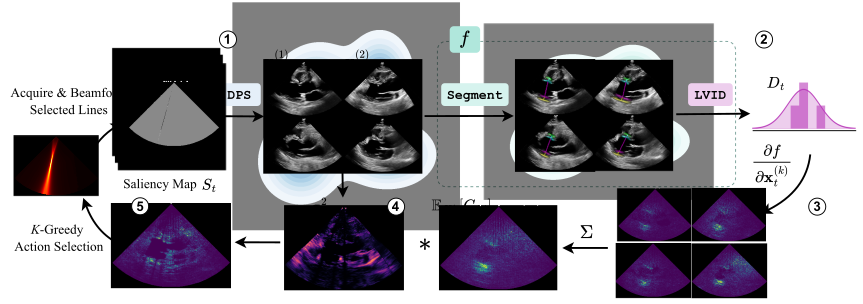 Diagram illustrating single iteration of the task-based perception-action loop using EchoNetLVH segmentation for the downstream task. ① Generate a set of posterior samples from the sparse acquisition using DPS. ② Pass each posterior sample $\mathbf{x}_t^{(i)}$ through the downstream task model $f$ to produce samples from the downstream task distribution. ③ Compute the Jacobian matrix using each of the posterior samples as inputs. ④ Average those Jacobian matrices and multiply them with the pixel-wise variance of the input images to produce the downstream task saliency map. ⑤ Apply $K$-Greedy Minimization to select $K$ scan line locations for the next acquisition.