Intravascular ultrasound (IVUS) offers a unique perspective in the treatment of vascular diseases by creating a sequence of ultrasound-slices acquired from within the vessel. However, unlike conventional hand-held ultrasound, the thin catheter only provides room for a small number of physical channels for signal transfer from a transducer-array at the tip. For continued improvement of image quality and frame rate, we present the use of deep reinforcement learning to deal with the current physical information bottleneck. Valuable inspiration has come from the field of magnetic resonance imaging (MRI), where learned acquisition schemes have brought significant acceleration in image acquisition at competing image quality. To efficiently accelerate IVUS imaging, we propose a framework that utilizes deep reinforcement learning for an optimal adaptive acquisition policy on a per-frame basis enabled by actor-critic methods and Gumbel top-K sampling.
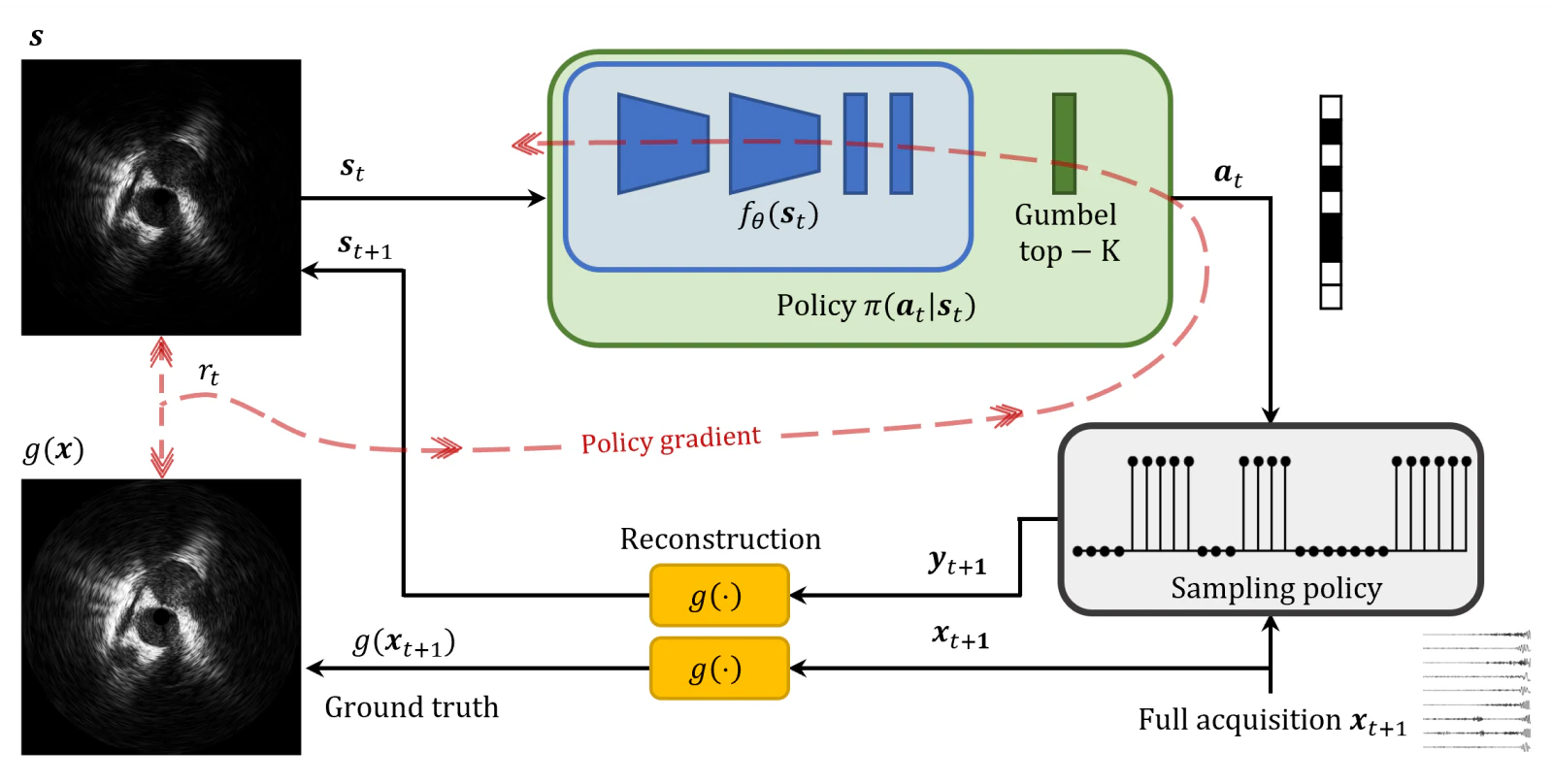
Block diagram of the perception-action-learning loop of the RL agent in an IVUS imaging setting.
RL in action on wire target
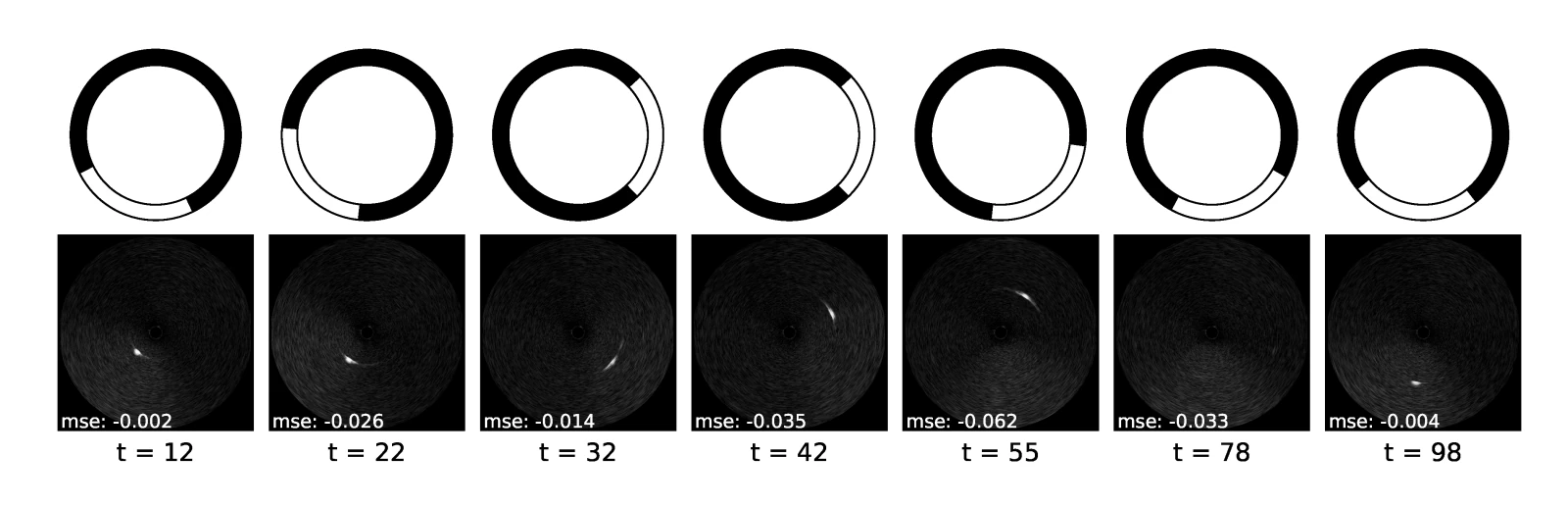
Successive wire phantom frames constructed using AiVUS. The agent's action is displayed in the top row, where the circle represents the elements in the transducer array: black represents 1 receiving element and white A receiving elements.